On Craft & Process: How I Approach Writing


A lot of discourse has been going on about AI and protecting yourself as a writer from accusations of generating stories with it. The prevailing wisdom seems to be that we should all have a letter outlining our process ready to go on demand. At the end of this post, I'll explain what I think about that advice, but for now, I would like to treat the rest of this as a very public letter outlining my writing process.
Daydreaming
The seed of a story
I've always been a daydreamer. I am constantly getting lost in my thoughts, imagining scenarios, and coming up with new worlds I'd prefer to live in over this one. My therapist tells me it's a common affliction for those of us with ADHD, and also a pretty common method of escapism for those with trauma. I have the little-t variety.
Like most creatives, I have more ideas than I could ever develop. Some are just interesting characters that I don't know what to do with, others are settings, and, of course, there are more "what if X was actually Y" ideas than I could shake a fist at.
It's why I go crazy when people pitch me ideas. Not only is it disingenuous to approach someone and ask them to do a bunch of work for you when all you bring to the table is an idea, but also, like, bro, I have the ideas. It's development I struggle with.
This daydreaming phase is usually where one of those characters, settings, or plots gets developed into something I consider good enough to write a story about. It's just a natural process of thinking about things over time, maybe stealing something from one idea and blending it with another, or coming up with something new that makes the whole thing feel like it works.
I try to keep a physical list of ideas too. That way, if I am struggling to develop something, I can park it for later review. A lot of these parked ideas end up helping later.
For instance, when I needed a third character for a grimdark fantasy concept I am working on, a magic system I developed for a splatterpunk story, and the character who wielded it, slotted in quite nicely. The character wasn't a copy-paste, but there was enough there to get the concept rolling.
Outlining
No longer a pantser
In full transparency, I used to be a pantser. Once an idea was developed enough from the daydreaming phase, I would just get to writing and hope my brain could figure it out from there.
That is no longer my process.
It starts with a notebook. The process here isn't super rigid, but I just start writing, by hand, pieces I believe are important to the story. Who are the characters I want? What are they like? How are they intertwined? What are the big scenes I feel need to be in the story? Then I start roughing out what I believe the general flow might be.
There's also a lot of talking to my wife during this phase. She's a great sounding board. I talk to her so much about my story outlines, characters, scenes, etc., that there are stories I have never actually written that she swears she has read.
I will confess, though, that even if I am better at outlining than I used to be, I am somewhat the pantser of outliners. The process is never exactly the same twice, and the notebook entries can look like the rambling machinations of a madman. Regardless, there is a process of lining up the structure of the story.
Writing
Okay, there is still some pantser in me....
I use Scrivener for longer-form work and Word for anything under a novelette. All AI features are turned off in both tools, just to be explicit. That means Copilot is off in Word, and when I use my Mac, Apple Intelligence is turned off. Scrivener, luckily, has no native AI features, so controlling AI at the OS level is a global decision.
When I first started writing, I used AutoCrit. I stopped as soon as I realized they were all in on jamming AI features into their platform.
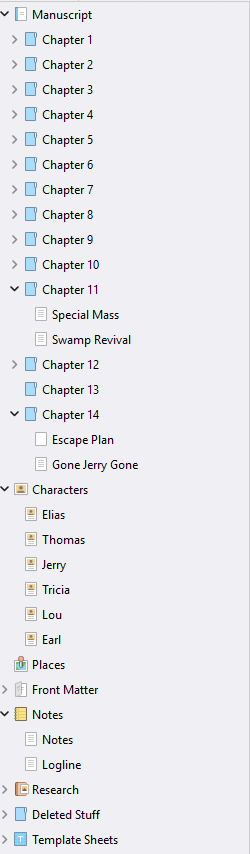
In Scrivener, I start by putting in some character sheets, any place references I may need again and again, and then try to get a structured outline into a text file. Once I have that, I structure my binder into folders for chapters and text files for key chapter beats and scenes.
I do it this way because there are times when a beat or scene works in the story but needs to be moved. It also lets me see the general flow of the story at a macro level before I put any words down, and sometimes issues become apparent that early.
One other thing I like to do in Scrivener is maintain a notes folder and a deleted folder. If I cut a large section, I don't want to lose that writing. You never know when it might be useful again. The notes section is a great place to write down things to check during editing, or to keep a running list of issues that need addressing without pulling myself out of the flow of putting words to paper.
Here's an example of how I have my current project set up. This is the fourth draft:
In Word, I don't do nearly this much work. As long as I have the outline in my mind, I just get to writing. In that way, I still fly by the seat of my pants.
I think I am what can best be described as a plantser. I plan as much as I am comfortable with, but I am never so rigid in my process that I don't allow myself to discover things as I go.
I aim for 1,000 words per day, every weekday. I give myself grace when things are tough, but that number is always in the back of my head, and I hit it about 80% of the time. Currently, I have been through some rough stretches personally over the last year and a half.
Version Control and Backups
Be meticulous, but not compulsive
I am pretty meticulous here. Autosave is on everywhere. All of my projects live in a folder that backs up to a cloud provider. At the end of every day, I put a copy of my work on an external drive. For a period of time, I actually used GitHub as a backup of the backups, but that became too compulsive.
Scrivener provides a log of when I write, which serves as evidence that I did not simply copy-paste some AI-generated slop all at once and call it my story. Word has worse versioning, but OneDrive helps prove a pattern of human creation.
I also keep every draft, both to embarrass myself and to show the evolution of the work. There's also a filing cabinet with marked-up versions of my stories if anyone is ever curious.
I work in IT and cybersecurity as my day job, so I am probably a bit extra, but I always tell folks to follow a 3-2-1 model when backing up their work: have three copies of your work, across two media types, with one at a different physical location.
Refinement
My one weakness, other than Portuguese food
I am terrible at revisions. Part of that is practice, and some of it is my default mode of being hyper-critical of everything I do.
My first rule is that nobody reads the first draft other than me. I write it, let it sit, and then go over the work with a critical eye to find what I think needs to change. I do this step mostly in my head and through the notes file in Scrivener.
Once I know what I want to tweak, I open the first draft next to a blank project. I then start the process of fully rewriting the work. No copy-paste. Every word is changed or retyped.
You find a lot of bullshit in your first draft by doing this, I find.
My first drafts are often quite clean and what many would consider a second draft, but I call them first drafts. Every day, I go back over the words I wrote the day before and make sure my prose and grammar are as clean as possible. I do the same in every subsequent revision. I find that I need fewer major revisions by micro-revising alongside redrafting.
With my 1,000-words-a-day goal, I can functionally revise 2,000 words a day when focused on one project.
When the second draft is done, I let it sit again, think about it, and then come back for more tweaks. Draft three is usually where I tighten up how characters sound, remove unnecessary or repetitive scenes, add new scenes, and kill my darlings.
The fourth draft is the last chance for major revisions. My current novella changed MCs in draft four. Then it is off to my wife for review.
While my wife marks up the story, I start a new project!
When I receive her markups, we discuss them, I make the final-final changes, and then it's all about polishing. Echoes, crutch words, adverbs, how the sentences sound when read out loud, all that stuff.
Edits
Different than refinement
God willing, after a few rejections, the story finds a home and I get to work with an editor.
All of that refinement I just did? Yeah, too bad, so sad. Here's more shit to fix or improve.
Guess what? Happy to do it!
I have never worked with an editor who did not materially improve my story. It's just a fact. They will catch the one typo you missed, and the reader will catch the one typo the editor missed. They will find ways to take the things that work and turn them up to eleven while muting or removing what is holding your story back.
This part of the process might be my favorite. I have gotten a story to the point where it is the best I can make it, and then an angel comes down from heaven and pushes my work to new heights.
On AI
The burden of proof
I wrote an entire two-thousand-word essay on my thoughts about AI. The best way to ensure you don't get accused of using AI is to not use AI.
The next best thing is to have a defined process that generates artifacts proving human creation. My process, as outlined above, does that.
But the truth is, short of leaving an AI prompt in your writing, there is no foolproof way of detecting AI use.
That, I think, is what makes this all so frustrating for writers and editors alike. As a writer, I am being asked to provide more and more evidence that I didn't use AI. At some point, proving I didn't use AI is going to require more work than writing my stories.
I don't have a good answer here. AI detectors suck.
I am happy to talk about any of my stories with anybody. I have started giving behind-the-scenes looks at my stories in an effort to show my creative process. Heck, I put my writing process on the internet for anyone to critique or use, in part to create another artifact showing that my work is 100% human-created.
I guess it is my hope that we move past this stage of paranoia-driven scrutiny, especially because it seems to be disproportionately impacting marginalized communities.
If you want my arguments against AI, you can check out my article HERE.
As always, thank you for trusting me with your time, and thank you for reading my words.


