Notebook: Fuck AI


I was always going to write about AI. It is a constant source of stress and ire in my life. But I would be lying to you if I said the timing of this had nothing to do with that recent HWA newsletter.
So why is AI bad?
Simple. It converts human labor and creativity into private profit without consent, shifts environmental and economic costs onto a public that did not ask for them, threatens jobs and professional development, follows a familiar pattern of speculative tech hype (remember how blockchain was going to change modern computing?), and weakens the cognitive skills it claims to enhance.
It is a bad bargain, dudes.
Let's start with a discussion of how AI works.
First, AI is a marketing term. These are large language models, or LLMs. How they work is kind of in the name. When you engage with one of these tools, it breaks your prompt down into chunks called tokens. It then uses statistical modeling to determine the next most likely token and repeats that process until it has produced a response.
It is predictive text on a grand scale, or, as I like to joke, it is Markov chains all the way down, baby.
That sounds simple, but the sophistication comes from the scale at which these models function. They contain billions of adjustable numerical relationships created by studying enormous, almost incomprehensible amounts of human writing.
Those statistical relationships allow the programs to recognize patterns involving grammar, style, facts, arguments, computer code, and associations between different ideas. Predicting enough language accurately enough can imitate comprehension, even though the system is really just generating an answer one statistically plausible piece at a time.
And that is why the AI industry stole everyone's writing, code, research, and everything else.
LLMs do not work unless they are trained on massive amounts of human-generated work. The modern AI industry treated the internet as its training ground. Your blog posts, books, videos, art, and code repositories were all used without your consent and without paying you.
The last model I could find whose dataset size was publicly disclosed was trained on roughly 225 billion words, or what I like to think of as around three million stolen novels' worth of text. Today's far more capable, multimodal models likely use substantially more.
Shit, these companies are so starved for human-created work, and receiving so much pushback for scraping the internet, that they are now buying physical books, shearing off the spines, scanning the pages, and adding the text to their training data.
Again, all under fair use, which is a crock of shit, and without paying the original creators.
There is also a very good chance that, if you are using one of these applications, anything you feed into it can be treated as training data under the terms and conditions you agreed to.
That is pretty rad, right?
Your work was stolen, and the only people profiting from that theft are the people who stole it. Your work is propping up, by my best estimate, around 1% of U.S. GDP, but none of the people whose work was taken are seeing that benefit.
What we are seeing instead is a negative impact on both the environment and the economy.
Hey, that is what we call a segue.
These applications, models, or AI tools, whatever you want to call them, require a shit ton of compute. Some of that comes from the scale at which they operate. Some of it comes from how terribly they handle context. Regardless, lots of compute means large data centers packed with racks full of GPUs.
Putting aside the ethics of the raw-material mining required to make those GPUs, and the working conditions in the factories where many of them are manufactured, the reality is that these data centers need enormous amounts of power to run.
The IEA expects global data center electricity consumption to roughly double over the next four years. Renewable energy will supply some of that demand, but fossil fuels will also be required. That means increased emissions and a greater impact on global warming.
Public utilities are already taking the brunt of this increased energy consumption, and they will likely continue to do so. I read somewhere that, by 2030, data centers could account for 12% of all U.S. electricity consumption.
I will give you one quick guess whose electricity bill goes up to subsidize that.
There are studies suggesting that data center growth could add an average of around $50 a month to a typical household's electric bill.
This is already getting long-winded, so excuse me for not getting into the water use, the heating of the ground around data centers, and all of the other environmental bullshit that comes with these things.
What we end up with is a familiar relationship: private companies receive the benefits while the communities most affected subsidize the costs.
Speaking of community impact, let's talk about the elephant in the room. If AI can do everybody's job, how the fuck are we supposed to pay our bills and feed our families?
Whether you believe AI can replace workers or not does not matter, because it is already being used as an excuse to cut jobs. From what I can find, and this is not tracked particularly well, AI has been cited in roughly 20% of layoff announcements this year. Anecdotally, the conversations I am having with people at the executive level suggest it is the reason far more often than that.
The real damage, though, may be what AI does to professional development.
I am not minimizing its impact on job loss. That harm is very real. But we are already starting to see companies bring experienced staff back in to fix what AI fucked up. The bottom of the career ladder, on the other hand, is being decimated.
AI is best at absorbing the routine work traditionally assigned to junior employees. I did not say it is particularly good at that work, only that it is what AI does best. It can produce a passable first draft of a document, spit out some boilerplate code, find articles that support a decision, or manage a calendar.
It is dumb stuff, but it is exactly the kind of dumb stuff decision-makers love because a $20-a-month subscription is easier to stomach than a $50,000-a-year salary for a new grad.
The data supports this decline in entry-level employment. Stanford researchers found that workers between the ages of twenty-two and twenty-five in occupations most exposed to AI experienced a 13% relative decline in employment.
That worries me as someone working in a field considered more likely to use AI than be replaced by it. It worries me because the skills I have today were built through years of experience. I did not wake up one morning able to solve the problems I solve or make the decisions I make without education, training, and time spent doing lower-level work.
If we do not let people step onto the first rung of the career ladder, we will not have anyone competent enough to climb higher when we need them.
The cynic in me believes that may be part of the plan.
If pressed, though, my experience tells me the AI bubble will pop. I have been in the tech industry too long to miss the clear signs of a hype cycle.
It starts with an innovation, usually a demo that looks like magic within carefully controlled constraints. For AI, that was the public launch of ChatGPT. From there, we hit inflated expectations, when every company rushes to release its own version or adopt the new technology. I would place that phase somewhere around 2024.
We are now living through the part where real-world limitations become apparent and the cost of implementation can no longer be ignored. What comes next is a consolidation of use cases and the companies capable of meeting them. Eventually, we will be left with some useful version of AI, one far less exciting than what Sam Altman and Elon Musk are pitching.
A bubble bursting does not mean the end of a technology. You are reading this on the internet, after all, and the internet survived the dot-com bubble. While I would be happier returning to a time when this technology did not exist, expecting the bubble to burst is not the same as wanting to return to the Stone Age, despite what AI champions would have you believe. Reorganizing society around promises that will never come true, if history holds, is a pretty dumb idea, though.
This brings me to what I believe is the strongest argument against AI.
It makes us dumber.
Not in the sense that it literally lowers our IQ, but in the sense that it weakens our cognitive abilities. The MIT Media Lab found that people who used AI to write essays showed weaker brain connectivity. Ouch. They also remembered less of what they had written and felt less ownership over the finished work than people who had not used AI.
Over time, the researchers concluded, this creates “cognitive debt”, or immediate convenience purchased by weakening the skills you need when the machine is unavailable or wrong.
A quick aside: the machine is often wrong.
If you do not have the expertise required to recognize when the machine is wrong, you should not be using the machine. Unfortunately, too many people see it as a replacement for acquiring that expertise in the first place. That is how you end up with vibe-coded applications that barely function.
Anyway, we are approaching the two thousand word mark, and I am losing steam. Let’s bring this thing home.
Most arguments for AI are bad-faith versions of the “no ethical consumption under capitalism” argument. They usually go something like this: “It is here to stay. It is already built into everything you use. Just accept it and live with it.”
That is a pretty silly argument, and one I hope people continue to push back against as strongly as they do today.
Here's award-winning horror author Michael Boulerice on the topic.
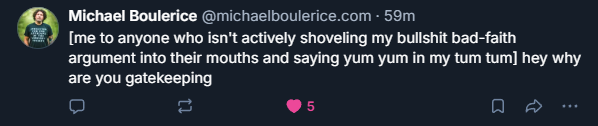
AI is built on the creative work of people who do not benefit from its creation, paid for by a society that does not seem to want it, and used to destroy the labor market while inflating an economic bubble that history tells us will burst.
Tech bros could never create art, so they built a machine that seems hell-bent on eliminating artists.
Fuck AI. Resist.
As always, thank you for trusting me with your time, and thank you for reading my words.
A quick note on citations: this is not a fucking research paper. I am an angry author who just so happens to be formally educated on the topic of AI. I felt it was my duty to ramble about it and put a relatively informed opinion into the world.
If any of my numbers or statistics are wrong, I apologize. I recited quite a few of them from memory. If you politely point out an error, I will check the source and update the post.


